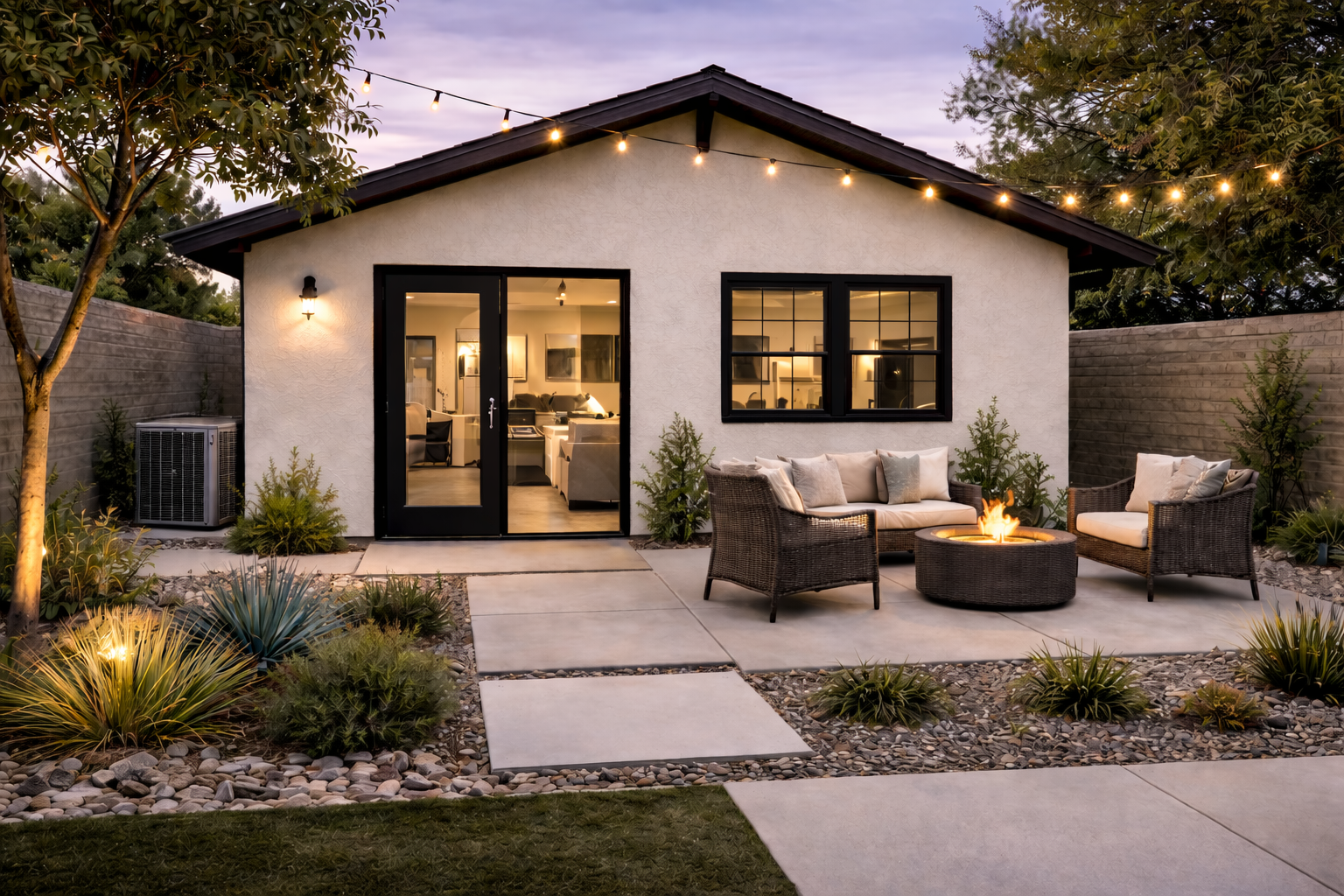
Accessory dwelling units — ADUs — are one of the most practical investments a homeowner in the East Valley can make right now. Whether you're converting a garage, building a detached casita, or finishing a basement with a separate entrance, the combination of added living space, rental income potential, and multigenerational flexibility is hard to beat.
But before a single wall goes up, you need to understand what your specific city allows. ADU regulations vary significantly across Tempe, Chandler, Gilbert, Mesa, and the rest of the metro — and getting this wrong at the start can cost you months of delays and thousands in redesign fees.
Here's what we know from actually building these, city by city.
What Is an ADU, Exactly?
An ADU (Accessory Dwelling Unit) is a secondary housing unit on the same lot as a primary single-family home. They come in a few forms:
- Detached ADU: A freestanding structure separate from the main house — a casita, a converted detached garage, or a newly built backyard unit.
- Attached ADU: An addition to the main home with its own entrance — often a converted attached garage or a bump-out addition.
- Interior ADU (JADU): A Junior ADU carved out of existing interior space, typically under 500 sq ft, with an interior connection to the main living area.
Arizona state law (SB 1103, effective 2023) has pushed cities to be more permissive about ADUs, which is good news for homeowners. But each city still sets its own size limits, setback requirements, and design standards.
Tempe
Tempe is one of the more ADU-friendly cities in the East Valley, partly because of its dense urban fabric and proximity to ASU. Key rules as of 2026:
- Maximum ADU size: 1,000 sq ft or 50% of the primary dwelling's floor area, whichever is less.
- Setbacks: 5 feet from side and rear property lines for detached units.
- Height: Maximum 16 feet for detached ADUs.
- Parking: One additional parking space required unless within ½ mile of a transit stop.
- Owner-occupancy: Currently not required — you do not have to live in the primary home to rent the ADU.
Permit turnaround in Tempe is typically 3–5 weeks for a complete ADU application. We've found Tempe's plan review team to be responsive and process-oriented — if your drawings are clean and complete, things move.
Chandler
Chandler has become more permissive in recent years, though it still requires careful attention to lot coverage limits.
- Maximum size: 1,200 sq ft.
- Lot coverage: The combined footprint of all structures (primary home + ADU + accessory structures) cannot exceed 45% of the lot area.
- Setbacks: 5 feet rear, 5 feet side for R-2 zones; varies in other residential zones — check your zoning designation.
- Height: 18 feet maximum for a two-story detached ADU.
- Design standards: Chandler requires the ADU's exterior materials and roof pitch to be compatible with the primary dwelling. This matters for budgeting — don't plan a metal-clad modern box behind a traditional stucco ranch without checking first.
Chandler is currently allowing online permit submission for ADU projects, which has cut the back-and-forth time considerably.
Gilbert
Gilbert has historically been more restrictive about ADUs than Tempe or Chandler, but state law has pushed it toward compliance. Current rules:
- Maximum size: 1,000 sq ft for detached; 50% of primary dwelling for attached.
- Setbacks: 5 feet rear and side for detached units in standard residential zones.
- Architectural compatibility requirements are enforced: the ADU must match the primary structure's roofline, materials, and window style.
- Short-term rentals (Airbnb/VRBO) from ADUs are subject to Gilbert's STR ordinance — registration and inspection required.
Gilbert's permit process tends to run 4–6 weeks for a complete ADU application. The town's building department is thorough. Bring complete plans.
Mesa
Mesa is the largest city in the East Valley and its ADU rules vary meaningfully by zone. The broad strokes:
- Maximum size: 800 sq ft in most single-family residential zones, up to 1,000 sq ft in some zones.
- Detached ADUs must maintain a minimum 10-foot separation from the primary dwelling.
- Setbacks are typically 5 feet rear and 5 feet side, but check your specific parcel — Mesa has a number of overlay districts with different standards.
- A separate utility meter is allowed but not required for ADUs under 800 sq ft.
Mesa's online permit portal (EPR) handles ADU submissions, and turnaround typically runs 3–5 weeks for over-the-counter eligible projects.
What the Process Actually Looks Like
Regardless of city, a permitted ADU project follows roughly the same sequence:
- Pre-application research. We verify your zoning designation, lot coverage, and any HOA restrictions (HOAs can be more restrictive than city code — check both).
- Design and drawings. Architectural plans showing floor plan, elevations, and site plan with setbacks dimensioned. For anything with structural work, a structural engineer's stamp is required.
- Permit submission. We submit on your behalf and manage the plan review correspondence.
- Plan review and corrections. First review typically takes 2–4 weeks. If corrections are requested, we respond and resubmit.
- Permit issuance and construction. Once approved, we pull the permit and begin. Inspections happen at key milestones: framing, rough electrical, rough plumbing, insulation, and final.
- Certificate of occupancy. The final inspection and CO sign-off make the ADU legally habitable and rentable.
"An unpermitted ADU is a liability. It won't survive a title search, it can't be legally rented, and it complicates your insurance. Do it right the first time."
Budget Expectations
A fully permitted ADU conversion in the East Valley typically runs:
- Garage conversion (attached, 400–600 sq ft): $55,000–$90,000
- Detached garage conversion (400–750 sq ft): $65,000–$110,000
- New detached ADU construction (500–1,000 sq ft): $120,000–$200,000+
The wide ranges reflect finishes, HVAC strategy (mini-split vs. extending existing system), plumbing complexity, and whether a separate utility meter is added. We'll give you a precise number after walking the site.