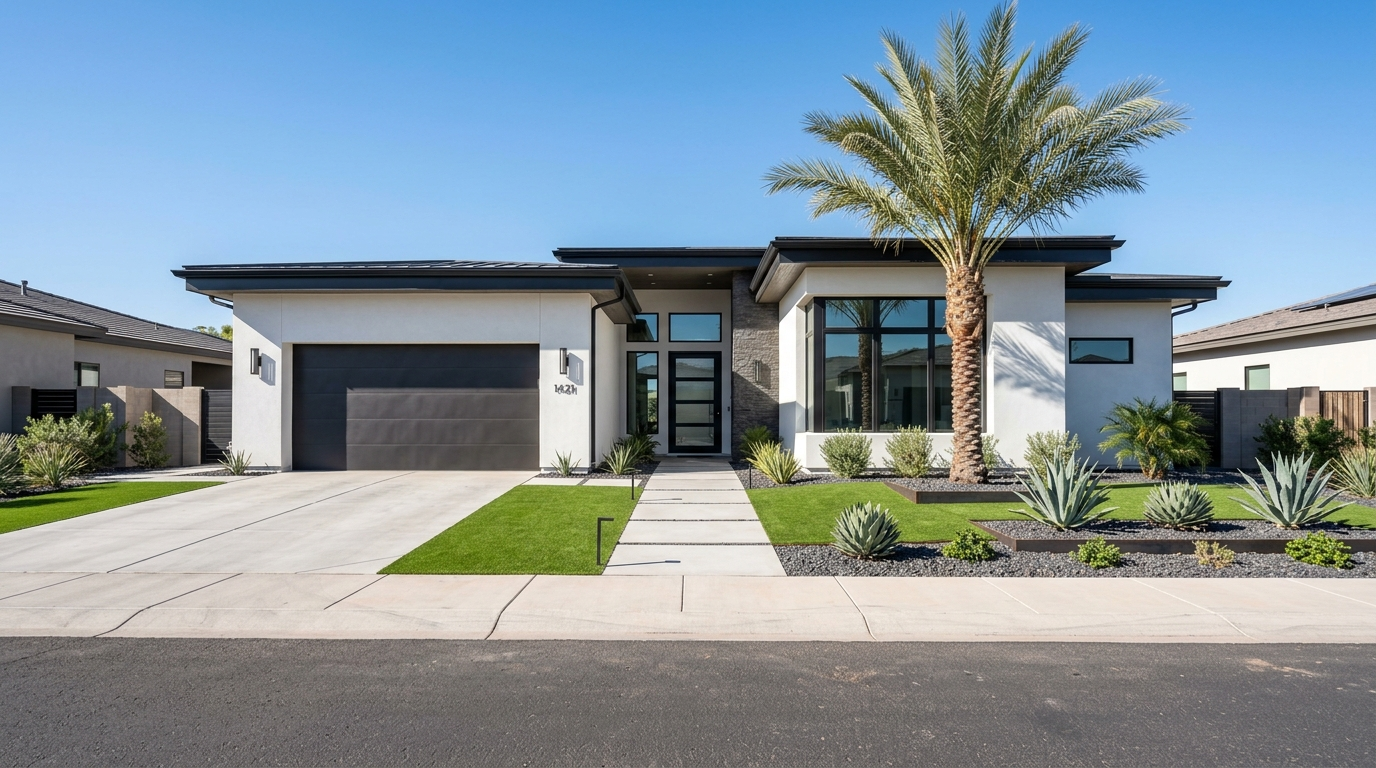
Building a custom home in Scottsdale is one of the most significant projects a homeowner will ever take on — and one of the most misunderstood. Most people underestimate how much happens before a shovel hits the ground, and overestimate how complicated it has to be with the right team behind it.
This guide covers the full process, in order — from figuring out what you actually want to build, to the day you get your certificate of occupancy. We've built custom homes across the East Valley, including several in Scottsdale, and the steps below reflect how a well-run project actually unfolds.
Step 1: Define Your Program Before You Look at Lots
A "program" is the list of spaces and functions your home needs to accommodate. It's the foundation everything else is built on — and most people skip it entirely, jumping straight to lot-shopping or Pinterest mood boards.
Before you do anything else, write down:
- Bedroom and bathroom count. Be specific about who's using each. A guest suite that doubles as a home office has different requirements than a standard guest room.
- Garage bays and storage. Scottsdale homeowners frequently underestimate garage requirements — golf carts, toy haulers, and workshop space all compete for square footage.
- Outdoor living expectations. In Scottsdale, the outdoor space is often as important as the interior. Pool, covered patio, outdoor kitchen, fire feature — decide early because these affect your lot size requirements and your structural design.
- Long-term use. Are you building to live in for 20 years? To sell in 5? To age in place? These produce meaningfully different designs. A home optimized for aging in place has wider doorways, a primary suite on the ground floor, and a different layout than a home optimized for resale.
- Square footage target and style. Get loose on this at first. A general range (3,000–4,500 sq ft, single-story, contemporary desert modern) gives your architect a starting point without locking you in prematurely.
A clearly written program protects you from costly design changes later and helps your architect give you an accurate fee estimate up front.
Step 2: Find the Right Lot — Scottsdale-Specific Considerations
Not all Scottsdale lots are equal. The city spans roughly 185 square miles — from dense Old Town corridors to sprawling north Scottsdale desert terrain with mountain views and minimal neighbors. What you can build depends heavily on where you buy.
Key factors to evaluate before purchasing any lot:
- Zoning designation. Scottsdale's residential zoning ranges from R1-10 (10,000 sq ft minimum lot) to R1-190 (190,000 sq ft minimum). Your zoning determines setbacks, maximum lot coverage, and height limits. Look up any parcel on the City of Scottsdale's Planning portal before making an offer.
- HOA and CC&Rs. Many Scottsdale communities — DC Ranch, Silverleaf, McCormick Ranch, Grayhawk — have their own architectural review committees that impose additional design standards on top of city code. These can restrict materials, roof pitch, exterior color palette, and landscaping. Review the CC&Rs in full before you buy. An HOA architectural approval process can add 4–8 weeks to your timeline.
- Caliche and soil conditions. North Scottsdale lots often have a layer of caliche (hardpan calcium carbonate) 12–36 inches below grade. Depending on depth and thickness, this can significantly affect foundation design and excavation cost. A geotechnical soil report ($1,500–$3,000) before purchase is money well spent on any raw lot.
- Slope and views. Hillside lots in the McDowell Sonoran Preserve corridors offer spectacular views but introduce grading costs, retaining walls, and potential hillside development overlay requirements that add complexity to permitting and construction.
- Utilities and access. Confirm water, sewer, gas, and electrical service availability. Some north Scottsdale parcels are on septic and well, which changes your infrastructure cost picture entirely.
- Flood zone. Arizona's desert washes can be deceptive. Check FEMA flood maps — some Scottsdale lots are in or near Zone AE (high-risk flood areas) which affects what you can build and what your insurance will cost.
"The lot purchase is where most custom home projects go wrong. Buyers fall in love with the view and don't do the due diligence. Find out what's actually buildable before you close."
Step 3: Understand Scottsdale's Permit and Zoning Process
Scottsdale Building Safety handles permit review for all new residential construction. Understanding the process up front prevents the delays that derail custom home timelines.
The sequence for a new custom home build:
- Pre-application conference (optional but recommended). For complex or large projects, Scottsdale offers a pre-application meeting with planning and building staff. This is your chance to surface any issues before spending money on construction documents. Worth scheduling if your lot is near a hillside overlay, has view corridor restrictions, or involves a split zoning designation.
- Design review (if required). Scottsdale has a Sensitive Design overlay and several community plan areas with additional design standards. If your lot falls under one of these, your architect's exterior design must pass a separate review before building permits can be issued. Check with Scottsdale Development Services early.
- Permit application submission. New single-family homes require architectural, structural, mechanical, electrical, and plumbing drawings. Your contractor and architect will assemble this package.
- Plan review. Scottsdale's residential plan review typically runs 4–8 weeks for a first-time custom home submission. Complex projects or incomplete submissions run longer. Your contractor should know what Scottsdale reviewers commonly flag and submit a clean package.
- Permit issuance and inspections. Once approved, permits are issued and construction can begin. Inspections occur at milestone stages: foundation, framing, rough MEP (mechanical, electrical, plumbing), insulation, drywall, and final.
Total permit timeline from submission to issuance: plan for 8–12 weeks on a typical custom home. Factor this into your overall project schedule before signing a lease on temporary housing.
Step 4: Assemble Your Team
A custom home build requires at minimum three professionals: an architect, a structural engineer, and a licensed general contractor. In Scottsdale, you'll often also need a civil engineer for grading and drainage plans, and a landscape architect if your HOA requires it.
- Architect. Choose someone with Scottsdale-specific experience. Local architects know what reviewers look for, which materials perform in desert heat, and how to orient a home for passive solar gain without turning west-facing glass into an oven.
- Structural engineer. Required for every new build. Your engineer stamps the structural drawings — foundation design, beam sizing, shear wall layout — that go into the permit package.
- General contractor. Your GC is accountable for the full construction process: managing subcontractors, coordinating inspections, controlling schedule, and keeping the budget honest. In Arizona, verify your GC holds an active license with the Arizona Registrar of Contractors (ROC). A licensed KB-2 designation covers residential general contracting statewide.
- Geotechnical engineer. For Scottsdale lots with unknown soil conditions, a geotech report informs your structural engineer's foundation design. Essential on hillside lots or anywhere caliche is suspected.
Hire your GC early — ideally during design development, not after drawings are complete. A contractor brought in at schematic design can flag constructability issues, provide preliminary budget feedback, and prevent the painful situation of getting permit-ready drawings back that are $300,000 over your budget.
Step 5: The Design Phase
Architectural design for a custom home moves through three phases, each building on the last:
- Schematic design (SD). Your architect develops rough floor plan options and a site plan showing how the home sits on the lot. This is where you react, refine, and make big-picture decisions about layout, orientation, and massing. The goal is a plan you're committed to moving forward with.
- Design development (DD). SD decisions are developed in detail: wall thicknesses, ceiling heights, window locations, material selections, structural system. Your contractor should be providing updated budget estimates at this stage.
- Construction documents (CD). Fully dimensioned, permit-ready drawings. This set is what gets submitted to Scottsdale Building Safety and what your GC bids and builds from. Changes after CDs are issued are expensive — make your decisions before this phase.
Expect the full design phase to take 4–6 months on a complex custom home. Rushing it costs you more in construction than you save in time.
Step 6: Budget Realistically for Scottsdale
Scottsdale is one of the higher-cost custom home markets in Arizona. Here's an honest picture of what to expect in 2026:
- Construction cost: $275–$450 per square foot for the home itself, depending on finishes, complexity, and site conditions. A 3,500 sq ft contemporary home with mid-to-upper finishes in north Scottsdale realistically lands at $1.1M–$1.4M in construction cost before soft costs.
- Soft costs: Architecture fees (8–12% of construction cost for a full-service design), structural and civil engineering, geotechnical report, permits, and HOA review fees. Budget 12–18% of construction cost for soft costs on top of the build.
- Site work: Grading, underground utilities, driveway, and landscaping are often not included in per-square-foot estimates. Scottsdale hillside lots can have $80,000–$200,000+ in site work before the foundation is poured.
- Contingency: Budget a 10–15% contingency on any custom home. Unknown soil conditions, utility connection surprises, and owner-directed changes during construction are normal — the contingency exists so they don't derail your project.
The National Association of Home Builders publishes annual cost-to-build data that's useful as a national benchmark, but Scottsdale's premium market and desert site conditions consistently track above national averages.
Step 7: Finance Your Build
Custom home construction is financed differently than a standard home purchase. The two most common paths:
- Construction-to-permanent loan. A single loan that covers the construction phase with interest-only draws as work progresses, then converts to a standard mortgage at certificate of occupancy. This is the most common structure for owner-occupied custom builds and requires a licensed contractor and approved construction contract to qualify.
- Construction loan + permanent mortgage (two-close). A standalone construction loan is paid off at completion, then replaced by a new mortgage. More flexible in some ways — you can shop the permanent mortgage rate separately — but involves two closings and two sets of closing costs.
Work with a lender experienced in construction loans. The draw schedule, inspection requirements, and documentation your lender needs should be communicated to your contractor at the start of the project, not mid-construction.
Step 8: Construction — What to Expect Phase by Phase
Once permits are issued and financing is in place, construction on a 3,000–4,500 sq ft custom home in Scottsdale typically runs 10–14 months. The phases:
- Site preparation and foundation. Clearing, grading, underground utility rough-in, and foundation forming and pour. On caliche-heavy lots, this phase takes longer and costs more than on clean sandy soil.
- Framing. The structural skeleton of the house goes up. Scottsdale custom homes are typically wood-framed, though ICF (insulated concrete form) and steel framing are used on some designs. Your structural engineer's drawings drive this phase.
- Rough MEP. Mechanical (HVAC ductwork), electrical (wiring and panels), and plumbing (rough-in) are installed inside the framed walls before they're closed. In Scottsdale's heat, HVAC design deserves serious attention — oversized equipment, proper Manual J load calculations, and well-sealed ductwork matter enormously for comfort and energy bills.
- Insulation, drywall, and exterior. Building envelope is completed: insulation, exterior stucco or cladding, roofing, windows, and exterior doors. This is also when Scottsdale's exterior design standards become visible in the finished product.
- Interior finishes. Flooring, cabinetry, countertops, tile, paint, fixtures, and trim. This phase is where your material selections become real — and where many projects run over schedule if decisions haven't been made in advance.
- Site finish and landscaping. Driveway, walkways, pool (if included), and desert landscaping. Scottsdale has landscape requirements in most residential zones — drought-tolerant plants, gravel, and minimal turf are the standard.
"The biggest schedule killers are material lead times and late owner decisions. Know what you're selecting before you need it. If your custom cabinetry has a 14-week lead time, that order needs to be placed during framing — not when the drywall is done."
Step 9: Final Inspections and Certificate of Occupancy
Construction isn't complete until Scottsdale Building Safety issues a certificate of occupancy (CO). The final inspection covers life-safety items: smoke and CO detectors, egress windows, handrails, GFCI and AFCI protection, and confirmation that all permitted work was completed as shown on the approved plans.
Your contractor is responsible for managing the inspection process and resolving any corrections. A well-run project typically passes final inspection in one or two visits. Projects with a lot of last-minute subcontractor coordination tend to generate punchlist corrections that delay CO — another argument for staying on top of schedule throughout construction.
Once you have your CO, you can legally occupy the home and your construction loan typically converts to your permanent mortgage. The project is done.
What Makes Scottsdale Different
A few things that make Scottsdale custom home projects distinct from the rest of the Valley:
- Design standards are real. Scottsdale takes architectural quality seriously. The city's design review process and HOA oversight in premier communities means you can't build a mediocre-looking home and expect it to sail through approvals. Budget for a good architect and quality exterior materials.
- The premium finish expectation is genuine. Scottsdale buyers and appraisers expect a certain level of finish. Cutting corners on countertops, flooring, and cabinetry to save money in a $1.5M custom home rarely makes sense — the appraised value gap rarely justifies the savings.
- North Scottsdale's terrain adds cost. Views, privacy, and desert character come with a price. Grade changes, retaining walls, longer utility runs, and difficult access all add to site costs. North Scottsdale is worth it for many buyers — just budget for it honestly.
If you're early in the process and want to understand what a custom home build in Scottsdale would actually cost and look like for your specific situation, the best next step is a conversation. We can walk through your lot, your program, and your budget — and give you a realistic picture before you've committed to anything.