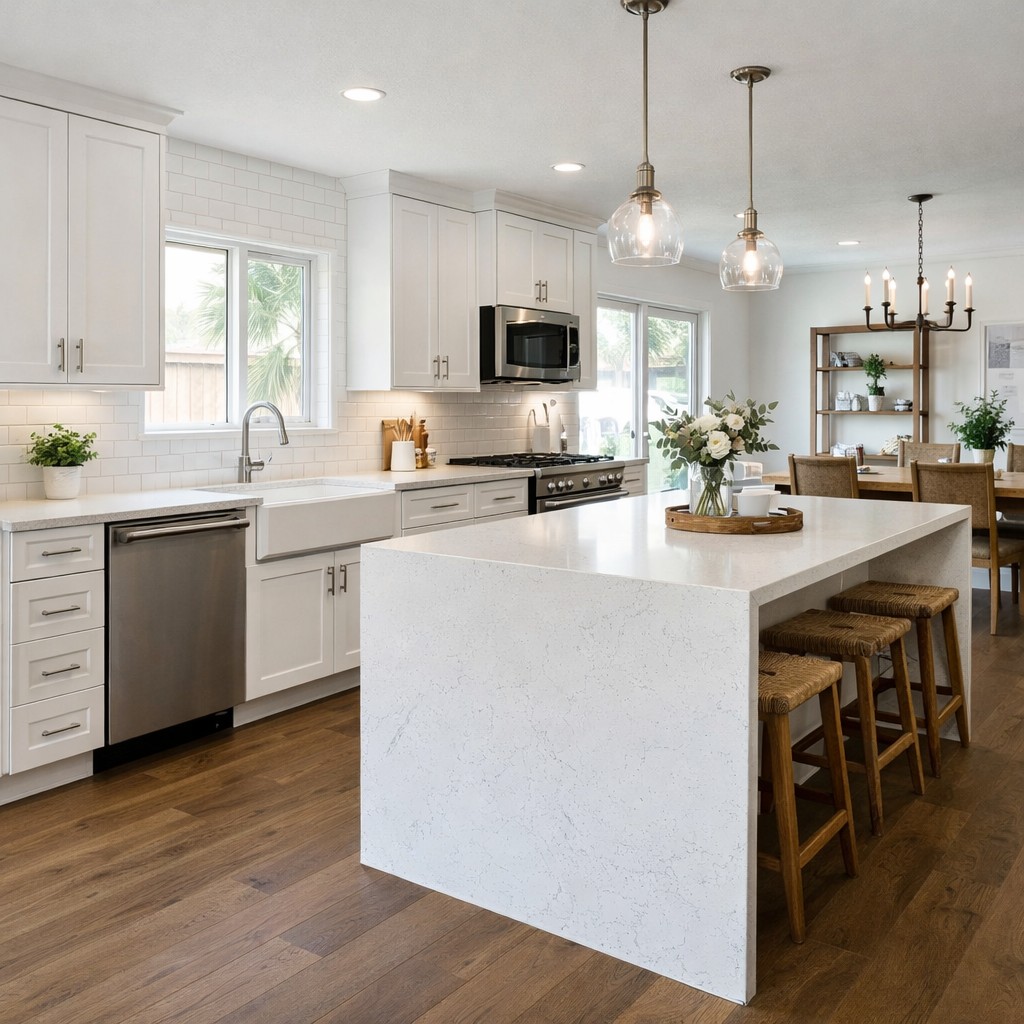
The most common countertop question we hear before a kitchen remodel: "Should we do quartz — or is there something better?" It's a fair question. Quartz has dominated showrooms and contractor conversations for the past decade, and for good reason. But "most recommended" doesn't mean "best for every situation." Here's how we actually think through this decision with homeowners across the East Valley.
The Short Answer
Quartz is still the most recommended countertop for most kitchens. It's non-porous, doesn't need sealing, is extremely durable, and comes in a range from budget-friendly to premium. For the majority of Gilbert, Chandler, Mesa, and Scottsdale homeowners remodeling a kitchen, quartz is the right call.
That said — yes, there are materials that outperform quartz in specific categories. If UV exposure, heat resistance, or a true natural stone aesthetic is your priority, there are better options. We'll get to all of them.
Why Quartz Became the Default
A decade ago, the kitchen countertop conversation was granite-or-nothing in most of the East Valley. Quartz took over for a handful of reasons that are all still valid:
- Non-porous by design. Because quartz is engineered — ground stone bound with resin — it has no natural pores. Wine, olive oil, coffee, and bacteria have nowhere to hide. You never have to seal it.
- Consistent color and pattern. Natural stone has variation between slabs. Quartz gives you the same look across every section, which makes large kitchens and waterfall islands far easier to execute.
- Durable without being fragile. Quartz scores around 7 on the Mohs hardness scale — harder than most things that will ever touch your countertop. It resists scratches from knives and chips from dropped pots better than marble or soapstone.
- Wide price range. Entry-level quartz (Silestone, MSI) runs $65–$85 per square foot installed. Mid-range (Caesarstone, Cambria) runs $85–$110. Premium lines go past $120. That range makes it accessible across nearly every budget tier.
"Quartz is the Toyota Camry of countertops. Reliable, widely available, great resale appeal, and appropriate for almost every situation. Not the most exciting answer — but usually the right one."
Is There Anything Better Than Quartz? (Yes — Depending on What You Need)
If UV Stability Matters: Dekton or Porcelain Slab
This is the one category where quartz genuinely has a weakness — and it matters significantly in Arizona. Some quartz products, particularly lighter colors, can discolor or develop a yellowish cast after years of direct UV exposure. It's not universal, and manufacturers like Cambria now publish UV test data. But if your kitchen faces west or south and receives hours of direct sun daily, you should think carefully.
Dekton (by Cosentino) and large-format porcelain slabs are fully UV-stable. They're also harder than quartz, heat-proof, and scratch-resistant. Dekton runs $100–$180 per square foot installed. Porcelain slab runs $80–$150. Both cost more than mid-range quartz, but they're the right call for sun-heavy Arizona kitchens — and they're increasingly popular in our Scottsdale and Gilbert projects.
If Natural Stone Is Important to You: Quartzite
Quartzite is not quartz — this trips up a lot of homeowners. Quartz is engineered. Quartzite is a natural metamorphic rock formed when sandstone is subjected to extreme heat and pressure. It's harder than granite, has a stunning marble-like appearance, and is more resistant to etching than marble.
The trade-off: quartzite is porous and needs to be sealed annually. It also costs more — typically $90–$200 per square foot installed depending on the slab. But if you want a countertop that looks like an heirloom piece of natural stone and you're willing to do basic maintenance, quartzite is a legitimate upgrade over quartz. We're installing it in more Scottsdale and Gilbert kitchens every year.
If You Cook Heavily and Set Hot Pans Down: Granite
Quartz is not heat-proof. The resin binders in quartz can discolor or crack under sudden temperature changes — a pan straight from a 500°F oven can damage the surface. Granite, being entirely natural stone, is heat-resistant. So is quartzite, dekton, and porcelain.
If you bake constantly, cook on high heat, and refuse to use trivets, granite or dekton are more forgiving choices than quartz.
If Drama and Aesthetics Are the Priority: Marble
Nothing looks like marble. The veining, the depth, the way it photographs — no engineered product has fully replicated it. The honest contractor answer on marble: it's a material for people who accept maintenance as part of the ownership experience. Marble etches from acidic contact (lemon juice, wine, tomato sauce). It scratches. It needs sealing. Over time it develops a patina that some people love and some people hate.
If you're designing a baking station, a low-traffic butler's pantry counter, or a statement island in a kitchen where aesthetics outweigh function, marble earns its place. Installed cost: $100–$250+ per square foot.
If Budget is the Priority: Modern Laminate
Laminate has shed its 1980s reputation. Modern laminate with realistic stone printing and matte finishes ($20–$60/sq ft installed) is a legitimate choice for rental properties, investment flips, and budget remodels. It's not repairable if damaged and it won't survive a flip in a high-end market, but it's not something to be embarrassed about either.
Full Countertop Comparison: Cost, Durability, and Maintenance
| Material | Installed Cost / Sq Ft | Sealing Required | Heat Resistant | UV Stable |
|---|---|---|---|---|
| Quartz | $65–$120 | Never | No | Varies by brand |
| Granite | $60–$110 | Annually | Yes | Yes |
| Quartzite | $90–$200 | Annually | Yes | Yes |
| Marble | $100–$250+ | Every 6–12 months | Yes | Yes |
| Dekton | $100–$180 | Never | Yes | Fully UV-stable |
| Porcelain Slab | $80–$150 | Never | Yes | Fully UV-stable |
| Laminate | $20–$60 | Never | No | No |
| Butcher Block | $40–$100 | Monthly oiling | No | Yes |
What We're Actually Installing in the East Valley Right Now
Based on projects we've completed across Gilbert, Chandler, Scottsdale, Mesa, and the broader Phoenix metro in 2025–2026:
- Quartz is about 55–60% of what we install. It's the dominant choice across all budget tiers, especially in family kitchens and mid-range remodels. Calacatta-style white quartz with gold or gray veining is the most requested pattern by a wide margin.
- Quartzite is growing fast — roughly 15% of our high-end projects. Homeowners in Scottsdale and north Gilbert who are spending $75K+ on a kitchen remodel increasingly prefer quartzite over quartz. The natural variation and premium feel justify the price at that level.
- Granite still holds steady at around 15%. It remains popular with homeowners who want natural stone on a budget that doesn't stretch to quartzite, and with older buyers who grew up with granite and trust it.
- Dekton and porcelain are rising — now about 10% and climbing. Sun-heavy kitchens, outdoor kitchen applications, and contemporary full-slab backsplash designs are all driving this. We expect it to be 15–20% within two years.
One note specific to the Phoenix metro: outdoor kitchen countertops are an entirely different calculation. Outside, quartz is a poor choice — UV exposure and temperature swings will shorten its life significantly. For outdoor applications, dekton, porcelain, or granite are almost always the right answer.
Which Countertop Is Right for You? A Quick Decision Guide
- You want zero maintenance and great resale value: Quartz.
- You cook heavily and set hot pans directly on the counter: Granite, quartzite, or dekton.
- Your kitchen gets hours of direct sun (west- or south-facing windows): Dekton, quartzite, or UV-tested quartz.
- You want natural stone with the marble look but less maintenance than marble: Quartzite.
- You want the most dramatic, high-design look and accept the upkeep: Marble.
- You have an outdoor kitchen or covered patio setup: Dekton or granite — not quartz.
- You want a mix — functional counters plus a warm island: Quartz perimeter counters plus butcher block island. A popular combination we build regularly in Gilbert and Chandler.
- You're flipping or renting the property: Modern laminate or budget granite — both deliver acceptable results at a price that makes the numbers work.
Once you've narrowed your countertop direction, you can build a free Cosmo Project Brief in about 90 seconds to see where your full kitchen scope lands — pick your tier, cabinets, and counter material, and we'll show you a realistic East Valley range with the math behind it.
A Word on Quartz Brands — They're Not All the Same
If you decide on quartz, the brand matters more than most people realize. Cambria (American-made) and Caesarstone publish third-party test data including UV stability. Silestone has been a reliable mid-range product for years. Generic or off-brand quartz products — the ones you'll find at warehouse pricing — are where the horror stories about discoloration and chipping come from.
We only specify quartz products from manufacturers whose warranty and quality standards we've vetted. If your contractor is showing you a quartz quote that seems unusually low, ask which manufacturer's product is specified. That's usually where the cost was cut.
Frequently Asked Questions
Is there anything better than quartz countertops?
Yes, depending on your priorities. Dekton and porcelain slab are harder, fully UV-stable, and heat-proof — better choices for sun-heavy Arizona kitchens or serious cooks. Quartzite is a natural stone with comparable durability and a more premium aesthetic. Granite handles direct heat better. Quartz is still the best all-around choice for most kitchens, but it does not win every category.
What is the most recommended countertop material?
Quartz is the most widely recommended by contractors and designers for general kitchen use. Non-porous, durable, low-maintenance, and available across a wide price range. For specialty applications — particularly in Arizona's intense sun — quartzite, dekton, or porcelain are often the better fit.
Does quartz last longer than granite?
Both last decades with proper care. Quartz is harder to chip and requires no sealing. Granite is more heat-resistant and develops a natural patina. Neither is definitively "longer lasting" — they perform differently based on how the kitchen is used.
What countertop is best for Arizona kitchens specifically?
Arizona's sun exposure is a real factor most national guides skip. For kitchens with significant western or southern sun exposure, we recommend UV-tested quartz (check the manufacturer's data), quartzite, dekton, or porcelain slab. For outdoor kitchens in the Phoenix metro, granite or dekton — quartz is not a good outdoor choice in this climate.
How do I choose between quartz and quartzite?
Quartz is engineered: consistent, non-porous, zero sealing. Quartzite is natural: unique patterns, requires annual sealing, and typically costs $30–$80 more per square foot. If you want zero maintenance and consistent looks, choose quartz. If you want natural stone with better durability than marble and a stunning veined look, choose quartzite. Both are excellent — it's a question of priorities.