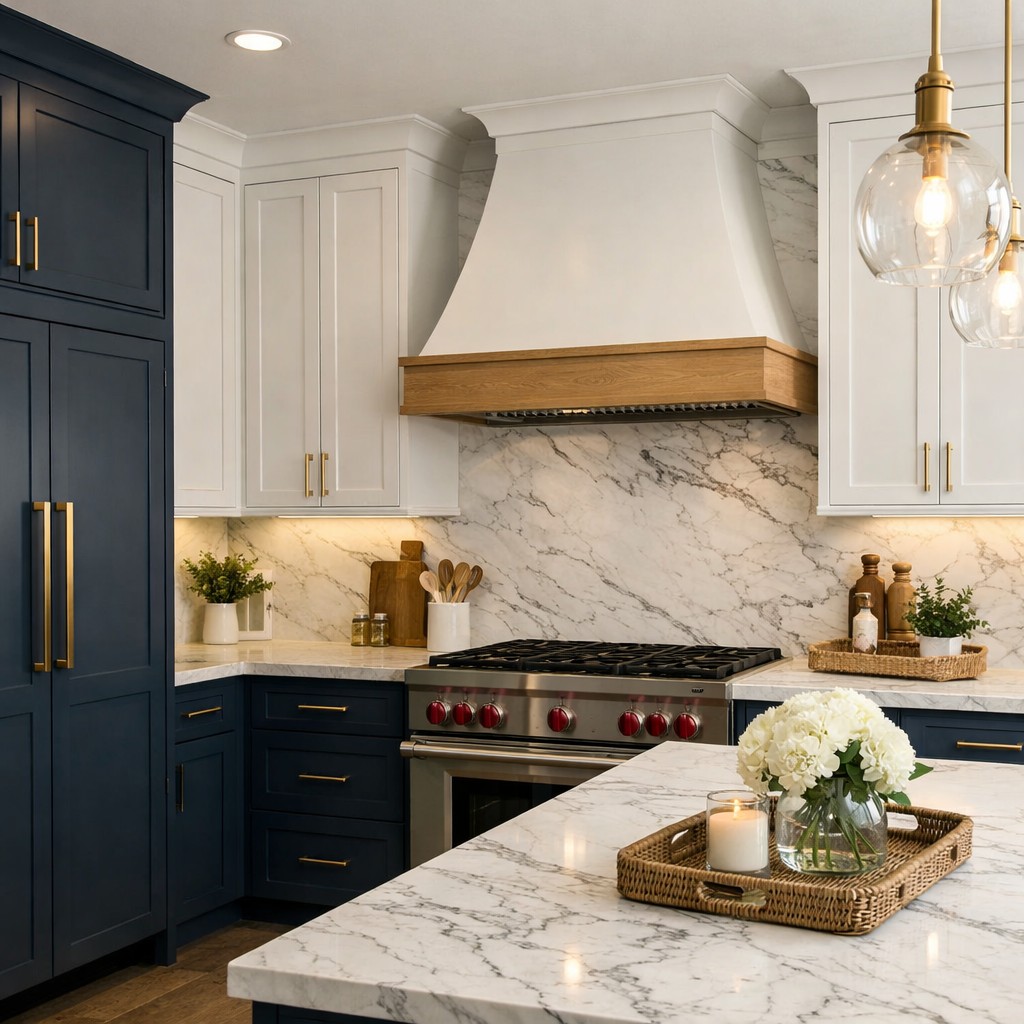
We build kitchens across the East Valley every week — in Gilbert, Chandler, Scottsdale, Mesa, and everywhere in between. What people are asking for in 2026 has shifted noticeably from even two years ago. Some of it is national trend trickling down, some of it is specific to how people in the desert actually live. Here's what we're seeing on the job site.
1. Two-Tone Cabinetry Is Everywhere — and It's Not Going Anywhere
The all-white kitchen peaked around 2018–2020. What replaced it wasn't a single color — it was contrast. Dark lowers, light uppers. A contrasting island in navy, forest green, or charcoal against perimeter cabinets in white or cream. We completed four of these in the first quarter of 2026 alone.
The combination that's showing up most often right now: warm white or off-white uppers with a deep navy or sage lower cabinet. It photographs beautifully, it hides wear on the lower cabinets (which take more abuse), and it breaks up the visual weight in large open kitchens.
What to watch out for: two-tone requires more precise finishing work. The transition line needs to be clean. If your contractor is rushing the paint or spray finish, it shows. We do our own finishing on every cabinet job.
2. Statement Range Hoods as Focal Points
The range hood is no longer an afterthought. In nearly every mid-range and high-end kitchen we're building right now, the hood is designed to be the visual anchor of the room — arched plaster, shiplap-wrapped wood, custom metal, or a bold contrasting color.
This trend makes sense in the East Valley specifically because so many kitchens here are open to a great room. The hood is visible from the living room, the dining area, sometimes even the entry. It's earned its moment.
Budget note: a custom built-out hood surround adds $1,800–$4,500 to a project depending on materials and complexity. It's one of the higher-ROI details we offer.
3. Integrated and Panel-Ready Appliances
The stainless steel wall of appliances is giving way to integrated panels — refrigerators, dishwashers, and sometimes even the range hood blower covered in cabinetry panels so the appliances disappear into the design. This used to be exclusively a luxury move. Sub-Zero and Miele have offered it for years. Now we're seeing it at the mid-range level too, with brands like Bosch and even GE offering panel-ready options at more accessible price points.
The tradeoff: panel-ready appliances cost 20–35% more than their standard counterparts, and they require more precise cabinet work to get the reveal spacing right. But the result — a kitchen that feels more like furniture than equipment — is something homeowners consistently love.
4. Warm Tones Are Replacing Cool Gray
The gray kitchen had a long run. Gray quartz, gray cabinetry, gray tile, gray walls. It's not dead, but it's clearly in retreat. What's taking over is warmth — creamy whites, warm greige cabinets, natural wood tones, terracotta and rust accents.
In the Arizona context, this makes particular sense. The warm light here — especially in the afternoon — makes cool grays look flat and washed out. Warm tones respond beautifully to natural light and feel more connected to the desert landscape outside.
We're seeing this in countertop choices too: less pure white quartz, more vein-heavy slabs with warm gold, brown, or green movement. Quartzite in particular is having a moment in the Scottsdale and Gilbert markets.
5. The Work Triangle Is Dead — Long Live the Work Zone
For decades, kitchen designers talked about the "work triangle" — the distance between the sink, stove, and refrigerator. That model was designed for single-cook kitchens. The reality of how people actually use kitchens in 2026 is more complex: multiple people cooking at once, dedicated prep zones, coffee stations, homework corners built into the island overhang.
We're designing for zones now: a primary cook zone, a prep/secondary zone, a cleanup zone, and a social zone at the island or peninsula. This shift is changing how we plan layouts, where we put secondary sinks, and how we think about traffic flow in open floor plans.
What's Fading
A few things we're seeing less of compared to 2022–2023:
- Open shelving on perimeter walls. People loved it in concept, hated it in practice. Dust, grease, and the constant pressure to keep it styled. Floating shelves above a counter run or on a single accent wall? Still great. Open shelving replacing upper cabinets entirely? Rare now.
- Waterfall edges on every island. The waterfall countertop edge is still beautiful, but specifying it on a standard island just because it's a trend is becoming less common. We're seeing more selective use — one dramatic feature piece rather than applying it universally.
- Farmhouse apron sinks as the default. Still beautiful in the right kitchen (we installed several last year), but no longer the automatic choice. Single-basin undermounts and workstation sinks with built-in accessories are gaining ground.
"The clients who end up happiest are the ones who design for how they actually live — not for what photographs well on Instagram."
How to Use This
Trends are useful context, not a mandate. The best kitchen we can build for you is one that works for how you actually cook, entertain, and move through your home — and that will still feel right in fifteen years. We'll walk you through options, show you real examples from our portfolio, and help you find the intersection of what you love and what performs well in your specific space.
If you'd like a rough budget range before we walk the space, you can build a free Cosmo Project Brief in about 90 seconds — pick your scope and tier, and we'll show you a realistic East Valley range.