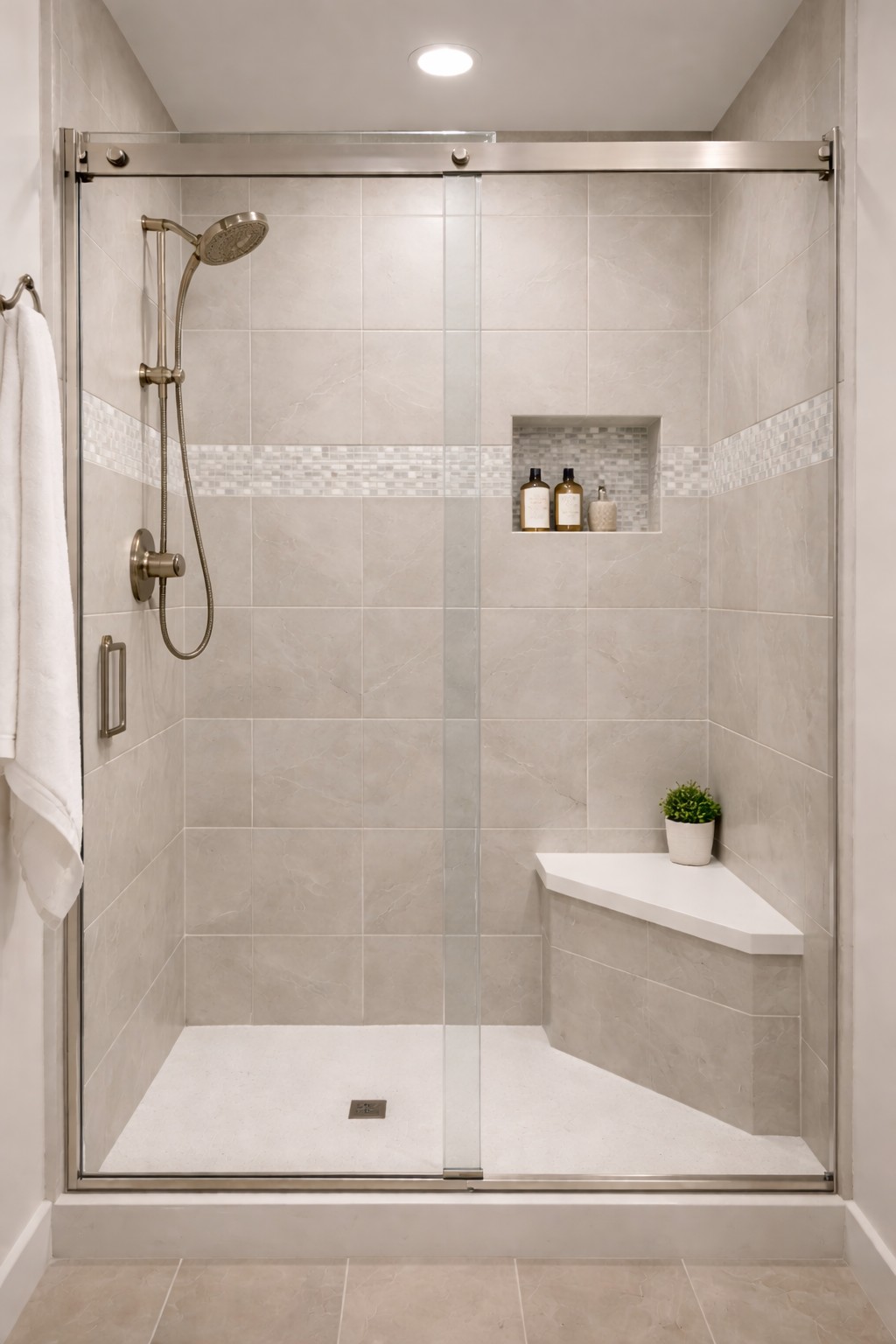
This is the single most-asked question we hear before a bathroom remodel: "Should we keep the tub or rip it out for a big walk-in shower?" It sounds like a design decision. It's actually three decisions tangled together — resale value, daily lifestyle, and whether anyone in the household plans to age in this house. Get those three straight and the answer usually picks itself.
The Short Answer
If you have at least two bathrooms and one already has a tub, convert the primary to a walk-in shower. That's the right call for the large majority of East Valley homeowners we work with — and it's what we install most often in Gilbert, Chandler, Mesa, and Scottsdale.
If your home only has one bathroom, or it's the only tub in the house and you're targeting families at resale, keep a tub somewhere. A modern tub + shower combo is not a downgrade — and removing the last tub from a 3-bedroom home is the one move that actually does narrow your buyer pool when you go to sell.
Almost everything past that is a question of budget, glass-vs-no-glass, and whether you're optimizing for daily showers or future resale. We'll walk through all of it.
Why Walk-in Showers Took Over the East Valley
A decade ago, almost every primary bathroom in Phoenix had a built-in tub. Today, the walk-in shower has become the default — to the point where most of our 2025–2026 primary-bathroom remodels are tub-removal conversions. There are real reasons:
- Adults rarely use the bathtub. The honest number, from years of asking clients during walkthroughs: most adult homeowners use their primary bathtub fewer than three times a year. Some never. A built-in tub that's used twice a year occupies 12–16 square feet of valuable bathroom real estate.
- Walk-in showers feel like a luxury upgrade. A frameless glass enclosure, full-height tile, a niche, a bench, and a rainhead is what buyers post on Instagram. A standard tub + shower combo is what came with the house.
- They photograph better. Real estate agents in Gilbert and Chandler will tell you a primary bathroom with a clean walk-in shower outperforms a tub + shower combo on listing-photo click-through. That matters more than it should.
- Aging in place is a bigger conversation than it used to be. Even homeowners in their 40s are asking us to design bathrooms that won't need to be redone in 20 years. A no-curb shower with a bench is the future-proof move.
- Hard water and Arizona deposits ruin tub finishes. Phoenix metro hard water leaves spots and scale on tub surrounds and faucets faster than most people expect. A tiled walk-in is easier to maintain and keep looking clean over a 10-year span.
"A primary bathtub used twice a year is 14 square feet of storage we could have given you instead. That's why walk-in showers won."
When a Tub + Shower Combo Is Still the Right Call
The walk-in trend is real, but it's not universal. Here's where we still build tub + shower combos — or recommend keeping a tub elsewhere even when the primary becomes a walk-in.
Families with Young Kids
Bathing a baby in a walk-in shower is miserable. Every parent who's tried it agrees. If you have small children or you're planning to in the next 5 years, you want a tub somewhere. It doesn't have to be the primary bath — the hall bath or guest bath works fine. But removing every tub from a family home is a regret a lot of homeowners write to us about a year later.
Single-Bathroom Homes
If your home only has one bathroom — common in older Phoenix bungalows, smaller Tempe rentals, and original 1950s Mesa homes — keep a tub. Period. Resale data is unambiguous on this: a one-bath home with no tub at all loses meaningful buyer interest. A tub + shower combo is non-negotiable in this configuration.
Soaking-Tub Buyers in Scottsdale and North Gilbert
In our high-end Scottsdale and Paradise Valley remodels, the conversation shifts. Some buyers genuinely use a soaker tub. Freestanding tubs (separate from the shower) are a status feature in primary bathrooms above the $40K remodel tier — and they're often paired with a large walk-in shower in the same room, not used as a shower replacement. That's a different decision than "tub vs shower." That's "do we have room for both?"
Resale in Family Neighborhoods
If your home is in a school-zoned family neighborhood — Cooper Commons, Power Ranch, Val Vista Lakes, large parts of Chandler and Queen Creek — keeping a tub somewhere is part of the resale calculus. It doesn't have to be the showcase bathroom. But it has to exist in the house.
You Actually Take Baths
The most overlooked reason: some people genuinely use their bathtub. If you're one of them, ignore everything above. Build the bathroom you actually live in, not the bathroom Instagram tells you to build.
The Real Resale Question
This is the single biggest fear we hear: "If I remove the tub, will it kill my resale?"
Here's the honest answer. We've watched dozens of East Valley listings sell over the past three years and tracked what we've actually seen:
- Removing the primary tub when another tub remains in the house: neutral to positive impact. A high-end walk-in shower in the primary bath usually outperforms a tub + shower combo at appraisal and for buyer reaction. We see this consistently in Gilbert, Chandler, and Scottsdale listings.
- Removing the only tub in a 3+ bedroom home: real negative impact. Family buyers and pet owners filter listings by tub presence. Investors flipping homes in Mesa and Phoenix know this and almost always keep one tub.
- Removing the tub in a Sun Lakes / 55+ community home: neutral to positive impact. The buyer pool here is largely empty-nesters and retirees. A high-end walk-in shower is often a selling point, not a liability.
- Removing the tub in a 1- or 2-bedroom home: neutral impact. Smaller homes, condos, and townhomes don't carry the same family-buyer expectation.
So the resale rule of thumb we give clients: keep a tub somewhere in the house. Not necessarily in the bathroom you're remodeling. Just somewhere.
Cost & Scope: What Each Option Actually Runs
We break down full bathroom-remodel pricing in our Chandler cost guide. Here are the line-item ranges for the shower-vs-tub piece specifically, current as of 2026 in the Phoenix metro:
Walk-in Shower — Conversion (Replacing an Existing Tub)
This is the most common project we build. Existing tub gets demoed, plumbing reworked, valve relocated to a side wall, new pan or curb framed, full waterproofing system installed (Schluter or equivalent), tile to ceiling, frameless glass enclosure.
- Standard conversion (mid-range tile, frameless glass): $7,000–$14,000 for a 36" × 60" footprint matching the original tub.
- Upgraded conversion (designer tile, niche, bench, dual valves): $14,000–$22,000.
- Curbless / zero-entry conversion (slab cut, linear drain): $18,000–$30,000+. The slab cut and waterproofing complexity drive the premium.
Walk-in Shower — New Construction or Full Reframe
Building a walk-in into a new floor plan or expanding into an adjacent closet. Larger footprints (48" × 60" up to 60" × 72"), more glass, often dual showerheads.
- Standard build: $10,000–$18,000.
- Upgraded primary-bath build (full-height tile, dual heads, rainhead, bench, niches, designer fixtures): $20,000–$45,000.
Tub + Shower Combo — Refresh
Keep the tub footprint and plumbing, replace the surround. New tub, new tile or solid-surround panels, new valve trim, new glass or curtain.
- Builder-grade refresh (acrylic tub, fiberglass surround): $3,500–$6,500. Common scope on rentals and investor flips.
- Mid-range refresh (cast-iron or steel tub, full tile surround, new valve): $7,000–$13,000. The right choice for most family bathrooms.
- Premium refresh (drop-in tub, designer tile, frameless glass): $14,000–$22,000.
Tub + Shower Combo — Full Replace with Reframe
Demo to studs, replace the tub, reframe the surround, full waterproofing, full tile. The right scope when the original wasn't waterproofed correctly and there's water damage in the wall.
- $10,000–$18,000 for a standard hall or guest bathroom.
Soaker Tub — Separate from the Shower
Freestanding or undermount tub installed separately from the main shower. This is an addition to a walk-in shower, not a replacement.
- Tub fixture only: $1,500–$8,000+ depending on whether it's a basic acrylic freestanding or a high-end cast-iron or stone resin model.
- Tub install with deck plumbing or freestanding floor-mount filler: $3,500–$9,000 on top of fixture cost.
- Total scope (when added to a primary remodel): typically $8,000–$20,000 as an upcharge.
Pick your scope, fixtures, and finish tier — our estimate planner shows you a realistic East Valley range with the math behind it. No call required.
Open the Estimate PlannerAging in Place: Where the Decision Becomes Simple
If anyone in the household plans to live in this home into their 60s, 70s, or beyond, the conversation changes. Stepping over a 14-inch tub wall is the most common cause of serious falls for adults over 65 in their own homes. The cost of one bad fall — broken hip, surgery, recovery, often a forced move — dwarfs any remodel.
For aging-in-place clients, particularly in Chandler's Sun Lakes, Trilogy at Encanterra, and parts of Mesa, our default recommendation is:
- Curbless or low-curb walk-in shower (zero or 2" maximum threshold)
- Linear drain sloped 1/4" per foot to one wall
- Built-in bench at 17–19" off the floor, minimum 15" deep
- Two grab bars, properly blocked into framing during rough-in (this is the cheap step you can't add later)
- Handheld wand on a slide bar, in addition to the fixed showerhead
- Non-slip floor tile, minimum DCOF 0.42, smaller mosaic or textured surface
- Frameless glass with a minimum 32" clear opening for future walker / wheelchair access
A bathroom built this way works for a 40-year-old today and an 80-year-old in 2066. A tub + shower combo doesn't.
Full Comparison: Walk-in Shower vs Tub Combo Options
| Option | Installed Cost | Best For | Resale Impact | Aging in Place |
|---|---|---|---|---|
| Walk-in Shower (Conversion) | $7K–$22K | Primary bath, 2+ bathroom homes | Neutral to positive | Good (curb still present) |
| Curbless / Zero-Entry Shower | $18K–$30K+ | Aging-in-place, premium primary baths | Positive in 55+ markets | Excellent |
| Tub + Shower Combo (Refresh) | $3.5K–$13K | Hall bath, guest bath, family homes | Positive (preserves the tub) | Poor |
| Tub + Shower Combo (Full Replace) | $10K–$18K | When prior install had water damage | Positive (preserves the tub) | Poor |
| Walk-in Shower + Separate Soaker Tub | $25K–$60K+ | Premium primary baths, Scottsdale tier | Positive in luxury market | Depends on shower spec |
| Acrylic Tub-Liner Conversion (Big-Box) | $5K–$11K | Fast cosmetic fix, no permits | Negative (looks aftermarket) | Limited (curb stays) |
What We're Actually Installing in 2026
Based on bathroom projects we've completed across Gilbert, Chandler, Mesa, Scottsdale, Tempe, Phoenix, and Queen Creek over the past 18 months:
- Walk-in shower conversions are about 65% of our primary-bath work. Tub-to-shower is the dominant scope. The frameless-glass-and-tile-niche package with a built-in bench is what we're building most often, across budgets from $9K up to $25K.
- Tub + shower combo refreshes are about 25% of our hall- and guest-bath work. Almost always in family homes where the primary already became a walk-in or where the tub is the only one in the house.
- Curbless / zero-entry showers are about 15% of our primary-bath work and growing fast. Sun Lakes, Trilogy, and aging-in-place clients in Chandler and Mesa are driving this. We expect it to be 25%+ within two years.
- Walk-in shower + separate soaker tub is about 10% of our work — concentrated in Scottsdale, Paradise Valley, and high-end North Gilbert. When the bathroom is large enough and the budget supports it, this is the configuration high-end buyers want.
- Standalone soaker-tub additions (no shower change) are about 5%. Almost always a primary-bath upgrade for clients who genuinely use a tub.
Which Is Right for You? A Quick Decision Guide
- Primary bathroom in a 2+ bath home, you rarely use the tub: Walk-in shower conversion. The default answer.
- Hall or guest bath in a family home: Keep the tub. Refresh or replace the tub + shower combo.
- Single-bathroom home: Keep the tub. Tub + shower combo with full replace is the right move.
- You're 55+ or planning to age in this home: Curbless walk-in shower with bench, grab-bar blocking, and handheld wand. Don't compromise here.
- You're in a Sun Lakes / Encanterra / Trilogy 55+ community: Walk-in shower across the board. The buyer pool wants it.
- You're flipping or renting the property in a family neighborhood: Mid-range tub + shower combo refresh in at least one bathroom. Don't strip the tubs.
- You're remodeling a Scottsdale or Paradise Valley primary bath above $40K: Plan for a walk-in shower and a separate soaker tub. That's what the market expects at that tier.
- You're in a 1- or 2-bedroom condo or townhome: Walk-in shower is fine. The family-buyer rule doesn't apply.
- You're not sure and your budget is tight: Tub + shower combo with a mid-range tile refresh. It's never the wrong answer in a hall or guest bath.
Once you've picked your direction, you can build a free Cosmo Project Brief in about 90 seconds to see where your full bathroom scope lands — pick your tier, fixtures, and tile, and we'll show you a realistic East Valley range with the math behind it.
A Note on the Big-Box Liner Conversions
You've seen the ads. "One-day bath remodel." "$10,000 walk-in shower." We get asked about these constantly. The honest answer: they're acrylic tub liners and surround panels installed over the existing tub structure. They take the curb with them. The materials are fine. The installation is fast. But they don't add resale value — appraisers and listing agents read them as aftermarket fixes, not real remodels — and they don't help with aging in place because the tub curb is still there.
If your goal is a fast cosmetic update on a budget and you don't care about resale or aging in place, they're a legitimate option. If your goal is to add real value to the home, a proper tile-and-glass walk-in conversion is what you want — even though it costs more and takes longer. There is no shortcut to a real remodel.
Frequently Asked Questions
Does removing a tub hurt your home's resale value?
Only if you remove the last tub in the house. Real estate data and our own experience in the East Valley show that a home needs at least one bathtub to compete with family buyers — typically in the guest or hall bath. Converting the primary bathroom's tub to a walk-in shower has neutral-to-positive resale impact in Phoenix-area markets when a tub remains elsewhere. Removing every tub from a 3+ bedroom home does measurably narrow your buyer pool and can hurt resale.
How much does it cost to convert a tub into a walk-in shower?
A standard tub-to-walk-in-shower conversion in the East Valley runs about $7,000 to $14,000 for a like-for-like footprint with mid-range tile and a frameless glass enclosure. Larger primary-bath conversions with curbless entries, custom tile, linear drains, and dual showerheads typically run $15,000 to $30,000+. Plumbing rework, slab cuts, and waterproofing are the biggest cost drivers.
Should every house keep at least one bathtub?
For 3-bedroom and larger homes in Phoenix metro family neighborhoods, yes. Buyers with young kids and pet owners almost universally want at least one bathtub. For 1- or 2-bedroom homes, condos, or homes targeting empty-nester / 55+ buyers (Sun Lakes, Trilogy, Encanterra), a tub is not required and a high-end walk-in shower often appraises and sells better.
Is a walk-in shower better for aging in place?
Significantly, yes. A curbless or low-curb walk-in shower with a built-in bench, grab bars, and a handheld wand is the single most impactful aging-in-place upgrade in a bathroom. Stepping over a tub wall is the leading cause of bathroom falls for adults over 65. For homes in Chandler's Sun Lakes, parts of Mesa, and any household planning to age in place, a walk-in shower is the default recommendation.
How long does a walk-in shower conversion take?
A standard tub-to-shower conversion takes about 2 to 3 weeks of active work — demo and rough-in (3–5 days), waterproofing and tile (5–7 working days, plus cure time), glass templating and install (7–10 days lead), and finish/punch list. From signed contract to a usable shower, plan on 4 to 6 weeks total when you account for permit timing and material lead times.